


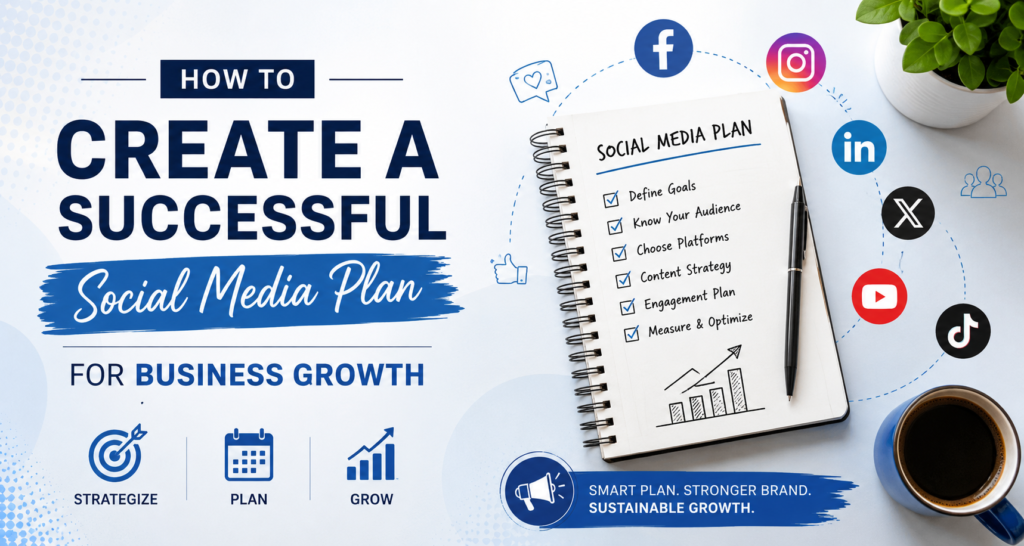
A strong social media plan is no longer optional for businesses. Whether you are a startup, small business, ecommerce brand, service provider, or established company, social media plays a major role in building brand awareness, attracting customers, generating leads, and improving online visibility.
But posting randomly on Facebook, Instagram, LinkedIn, or other platforms is not enough. To get real results, you need a clear social media marketing plan that connects your business goals, target audience, content strategy, posting calendar, paid ads, analytics, and conversion objectives.
A successful social media plan helps you understand what to post, where to post, when to post, and how to measure performance. It also gives your brand a consistent voice and direction across all social media platforms.
In this guide, we will explain how to create a successful social media plan step by step and how working with a professional social media agency or the best SMO company in India can help businesses grow faster.
What Is a Social Media Plan?
A social media plan is a structured roadmap that defines how a business will use social media platforms to achieve marketing goals. It includes objectives, audience research, platform selection, content planning, posting schedule, engagement strategy, paid promotion, analytics, and performance improvement.
In simple words, a social media plan helps your brand move from random posting to result-driven social media marketing.
A good plan answers important questions like:
- Who is your target audience?
- Which social media platforms should your business use?
- What type of content should you create?
- How often should you post?
- What budget should you spend on paid ads?
- Which metrics should you track?
- How will social media support sales and brand growth?
This is why every business needs a proper social media strategy before investing time and money into content creation or advertising.
Why Is a Social Media Plan Important?
A well-planned social media strategy gives your business direction. Without a plan, brands often post inconsistent content, target the wrong audience, waste ad budget, and fail to measure performance.
Builds Strong Brand Awareness
Social media helps people discover your brand. A clear content plan ensures that your business appears consistently in front of the right audience with the right message.
Improves Audience Engagement
When you understand your audience’s interests, pain points, and behavior, you can create content that encourages likes, comments, shares, saves, and messages.
Helps Generate Leads and Sales
A strong social media marketing plan connects content with business goals. It guides users from awareness to interest, inquiry, and finally conversion.
Saves Time and Effort
A content calendar helps you plan posts in advance. This avoids last-minute confusion and keeps your social media activity consistent.
Tracks Real Performance
With proper social media analytics, you can measure what is working and what needs improvement. This helps you make better decisions based on data.
Step 1: Define Clear Social Media Goals
The first step in creating a successful social media plan is defining your goals. Your goals should be specific, measurable, achievable, relevant, and time-bound.
Instead of saying, “We want more followers,” a better goal would be: “We want to increase Instagram followers by 25% in 3 months through educational reels, product posts, and influencer collaborations.”
Your goals will decide your content format, posting frequency, platform choice, advertising budget, and performance metrics.
- Increasing brand awareness
- Driving website traffic
- Generating leads
- Improving engagement
- Building community
- Promoting products or services
- Increasing ecommerce sales
- Improving customer support
- Building trust and authority
Step 2: Understand Your Target Audience
A social media plan becomes effective only when it is built around the right audience. Before creating content, you need to understand who your ideal customers are and what they care about.
Creating buyer personas can make this process easier. A buyer persona is a simple profile of your ideal customer.
Buyer Persona Example: A 28-year-old business owner from India who wants to grow online visibility, generate leads, improve brand reputation, and is searching for a reliable social media agency or SMO company to manage social media marketing.
When you know your audience clearly, your content becomes more relevant, useful, and engaging.
- Age group
- Gender
- Location
- Profession
- Interests
- Buying behavior
- Pain points
- Content preferences
- Preferred social media platforms
- Common questions and objections
Step 3: Conduct Competitor and Market Research
Market research is an important part of every social media strategy. It helps you understand industry trends, competitor activity, content gaps, and audience expectations.
This does not mean copying competitors. It means understanding what works in your industry and finding opportunities to create better content.
For example, if competitors are posting only promotional content, your brand can stand out by creating educational content, comparison posts, customer stories, behind-the-scenes content, and problem-solving reels.
- What competitors are posting
- Which posts get high engagement
- What content formats they use
- Which platforms they are active on
- How often they post
- What hashtags and keywords they use
- How they respond to comments and queries
- What type of offers or campaigns they run
Step 4: Choose the Right Social Media Platforms
Not every business needs to be active on every platform. A successful social media plan focuses on platforms where the target audience is most active.
Facebook is useful for community building, local businesses, paid ads, groups, events, and broad audience targeting. Instagram is ideal for visual branding, reels, product promotion, lifestyle content, influencer marketing, and ecommerce brands. LinkedIn works best for B2B companies, professional services, thought leadership, hiring, networking, and lead generation. YouTube is powerful for long-form videos, tutorials, product explainers, reviews, educational content, and search-based visibility. X / Twitter is useful for real-time updates, news, opinions, conversations, and industry commentary. Short-video platforms are useful for brands targeting younger audiences through creative, entertaining, and trend-based content.
The best platform depends on your goals. For example, a B2B software company may focus more on LinkedIn and YouTube, while a fashion or lifestyle brand may focus more on Instagram and Facebook.
Step 5: Create a Strong Content Strategy
Content is the heart of every social media marketing plan. Your content should not only look good but also educate, engage, inspire, and convert your audience.
A balanced social media content plan should not be only promotional. Ideally, your content mix should include education, engagement, trust, and conversion.
- Educational content: tips, guides, tutorials, industry facts, and how-to posts
- Promotional content: product posts, service highlights, offers, launches, and sales-driven posts
- Engagement content: polls, quizzes, questions, memes, contests, and interactive stories
- Trust-building content: testimonials, reviews, case studies, client results, behind-the-scenes content, and founder stories
- Trend-based content: reels, trending audio, industry updates, and timely posts
Step 6: Build a Social Media Content Calendar
A content calendar is a schedule that tells you what to post, when to post, and where to post. It keeps your social media activity consistent and organized.
Your content calendar should include date of posting, platform name, content topic, caption idea, creative format, target keyword or theme, hashtags, CTA, and post status.
| Day | Platform | Content Type | Topic | CTA |
| Monday | Reel | 5 tips to improve engagement | Follow for more tips | |
| Tuesday | Educational Post | Why businesses need social media planning | Visit our website | |
| Wednesday | Promotional Post | Social media management services | Contact us today | |
| Thursday | Carousel | Social media mistakes to avoid | Save this post | |
| Friday | Case Study | How planning improved brand visibility | Book a consultation |
Step 7: Use Paid Social Media Advertising
Organic content is important, but paid advertising can help your brand reach a larger and more targeted audience.
Paid social media ads can be used for brand awareness, website traffic, lead generation, product sales, app installs, retargeting, event promotion, and offer campaigns.
Platforms like Facebook, Instagram, LinkedIn, and YouTube allow businesses to target users based on location, interests, age, behavior, job title, and previous website visits.
To get better results from paid ads, test different creatives, captions, audiences, placements, and landing pages. Track your cost per click, cost per lead, conversion rate, and return on ad spend. A professional social media agency can help plan, run, and optimize paid campaigns for better ROI.
Step 8: Add Influencer Marketing to Your Plan
Influencer marketing can help your brand reach a wider audience and build trust faster. People often trust recommendations from creators, experts, and industry personalities.
When choosing influencers, do not focus only on follower count. Instead, check audience quality, engagement rate, content style, brand fit, previous collaborations, authenticity, and niche relevance.
Micro-influencers can often deliver better engagement than large influencers because their audience is more specific and loyal. Influencer marketing works well for product launches, brand awareness campaigns, reviews, tutorials, and user-generated content.
Step 9: Engage With Your Audience
Social media is not only about posting content. It is also about building conversations.
Your brand should actively reply to comments, respond to messages, answer questions, thank followers, share user-generated content, handle complaints professionally, and ask questions through stories and polls.
Engagement improves brand loyalty and tells social media algorithms that your content is valuable. A good social media plan should include time for community management, not just content publishing.
Step 10: Track Social Media Performance
Measuring performance is essential for improving your social media strategy. Without tracking, you cannot know whether your content is working.
| Metric Type | Examples |
| Awareness Metrics | Reach, impressions, follower growth, profile visits |
| Engagement Metrics | Likes, comments, shares, saves, story replies, engagement rate |
| Traffic Metrics | Link clicks, website visits, landing page views, click-through rate |
| Conversion Metrics | Leads, sales, form submissions, calls, purchases, return on ad spend |
| Customer Metrics | Message response time, reviews, sentiment, customer feedback |
Step 11: Improve Your Strategy With Data
A successful social media plan is never fixed forever. It should improve based on performance data.
If reels are getting more reach, create more short videos. If carousels are getting more saves, create more educational posts. If paid ads are generating leads but not conversions, improve the landing page or targeting.
You can test different posting times, caption styles, hashtag groups, creative formats, ad audiences, CTA lines, content topics, and video lengths. Data-driven decisions help your business grow steadily and reduce wasted effort.
When Should You Hire a Social Media Agency?
Managing social media can become time-consuming, especially when your business needs regular content, creative design, paid ads, analytics, reporting, and customer engagement.
Hiring a professional social media agency or SMO company can be helpful when:
- You do not have an in-house marketing team
- You want consistent posting
- You need better content quality
- Your social media growth is slow
- You want to run paid ads
- You need monthly performance reports
- You want expert strategy and execution
- You want to focus on your core business
A good agency can help with content planning, graphic design, video ideas, caption writing, ad management, influencer campaigns, reporting, and complete social media management.
How to Choose the Best SMO Company in India
Choosing the right SMO company is important because your social media presence directly affects your brand image.
Experience and Expertise
Choose an agency that understands social media strategy, content creation, paid advertising, analytics, and brand positioning.
Industry Understanding
The agency should understand your business category, audience behavior, and competition.
Content Quality
Review their previous creatives, captions, reels, campaigns, and brand pages.
Transparent Reporting
A reliable SMO company should provide clear monthly reports with reach, engagement, followers, traffic, leads, and campaign performance.
Communication
Good communication is important. The agency should understand your goals, take feedback, and share regular updates.
Result-Oriented Approach
Avoid agencies that only focus on posting. Choose a partner that focuses on growth, engagement, leads, and business outcomes.
The best SMO company in India will not just post content for you. It will create a complete social media plan that supports your marketing and business goals.
How to Create a Social Media Plan?
To create a social media plan, first define your business goals and target audience. Then choose the right platforms, create a content strategy, prepare a content calendar, use paid ads if needed, engage with your audience, track performance metrics, and improve your strategy using analytics.
Social Media Plan Checklist
- Define business goals
- Identify target audience
- Create buyer personas
- Research competitors
- Select the right platforms
- Plan content pillars
- Create a monthly content calendar
- Write platform-specific captions
- Design creatives and videos
- Add hashtags and keywords
- Plan paid advertising
- Engage with followers
- Track analytics
- Review monthly performance
- Improve strategy based on data
Common Mistakes to Avoid in Social Media Planning
Many businesses fail on social media because they do not follow a structured plan. Avoid these common mistakes:
- Posting without clear goals
- Targeting everyone instead of a specific audience
- Using the same content on every platform
- Posting only promotional content
- Ignoring comments and messages
- Not tracking analytics
- Not using a content calendar
- Running ads without testing
- Copying competitors blindly
- Not maintaining brand consistency
FAQs About Social Media Plan
What is a social media plan?
A social media plan is a strategic roadmap that explains how a business will use social media platforms to achieve goals like brand awareness, engagement, leads, traffic, and sales.
Why does a business need a social media plan?
A business needs a social media plan to stay consistent, target the right audience, create better content, measure performance, and get better results from social media marketing.
Which social media platform is best for business?
The best platform depends on your audience and goals. Instagram is good for visual brands, LinkedIn is strong for B2B, Facebook works well for community and ads, and YouTube is useful for educational video content.
How often should a business post on social media?
Most businesses should post at least 3 to 5 times per week. However, quality matters more than quantity. A consistent and valuable content calendar gives better results than random posting.
What should be included in a social media content calendar?
A content calendar should include posting date, platform, topic, caption, creative format, hashtags, CTA, campaign theme, and post status.
How can a social media agency help my business?
A social media agency can help with strategy, content creation, posting, paid ads, influencer marketing, community management, analytics, and monthly reporting.
How do I choose the best SMO company in India?
Choose an SMO company based on experience, content quality, industry knowledge, communication, reporting transparency, paid ad expertise, and ability to deliver measurable results.
Conclusion
A successful social media plan helps your business move from random posting to strategic growth. It gives your brand a clear direction, helps you understand your audience, improves content quality, increases engagement, and supports business goals like leads, traffic, and sales.
To build an effective social media marketing plan, start with clear goals, choose the right platforms, create useful content, maintain a content calendar, use paid ads wisely, engage with your audience, and track performance regularly.
If your business wants expert support, working with a professional social media agency or the best SMO company in India can help you save time, improve consistency, and achieve better social media results.
A strong social media presence is not built in one day. It requires planning, creativity, consistency, and continuous improvement. With the right social media strategy, your brand can build trust, reach the right audience, and grow online with confidence.